Introduction
The difference between open and closed transition auto transformer starting is the cost of one timer the benefit is that the motor remains connected to the power supply throughout the starting period. That places less strain on the motor and the run contactor and consequently increases their life. It is for that reason the open transition version of auto transformer starting is not considered in this article.
Power Circuit
Control Circuit
Circuit Operation
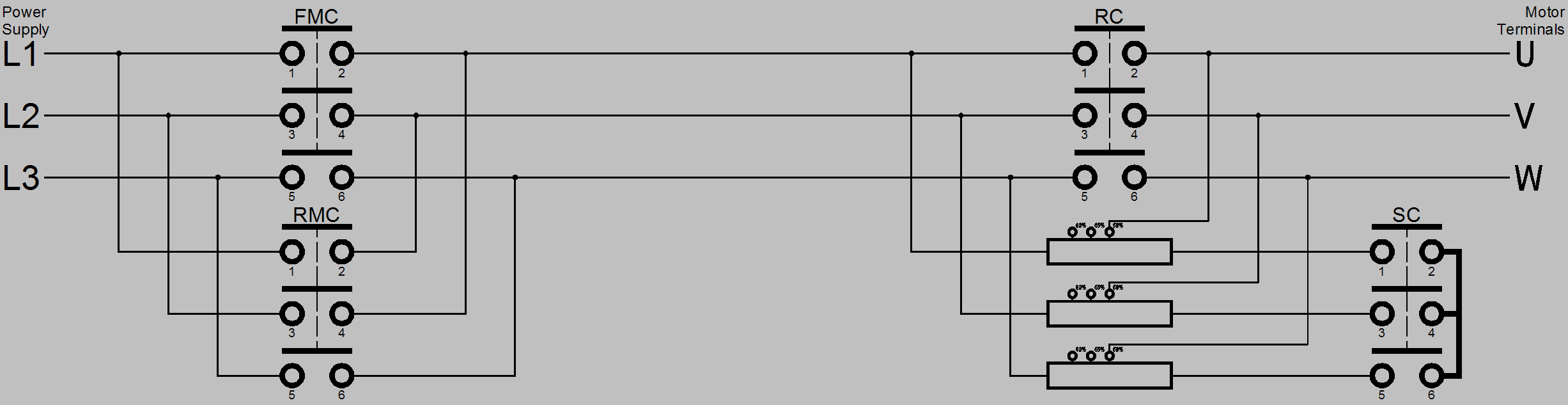
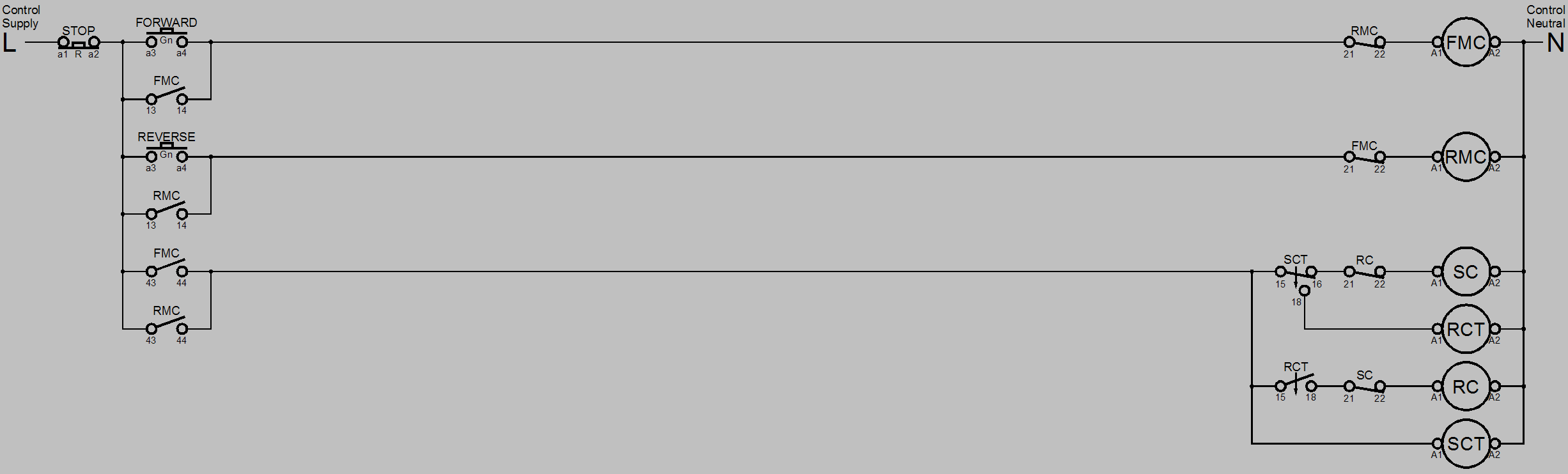
The contact on terminals a3-a4 of each start push button energises the required direction contactor, either the forward main contactor FMC or the reverse main contactor RMC, the relevant main contacts 1-2, 3-4 and 5-6 close which puts power; with either clockwise or anticlockwise phase rotation; to the motor terminals, normally open auxiliary contacts of the relevant direction contactor on terminals 13-14 close to maintain the power to that direction contactor when the button is released.
When either the forward or reverse button is pressed its contacts a3-a4 close, the relevant main contactor coil FMC or RMC is energised which causes the it’s main contacts on terminals 1-2, 3-4 and 5-6, normally open auxiliary contacts on terminals 13-14 and 43-44 to close and the normally closed auxiliary contact on terminals 21-22 to open. The auxiliary contact maintains power to it’s contactor coil when the forward or reverse button is released. At the same time the main contactors second normally open contact on terminals 43-44 closes and the star contactor coil SC is energised which causes the main contacts on terminals 1-2, 3-4 and 5-6 to close. Power is connected from the power supply to the motor terminals U, V and W at a reduced voltage and the motor will start and accelerate in the selected direction to a speed determined by the load. At the same time the star contactor timer SCT energises which causes it to start its timing cycle. After a preset time the star contactor timer times out the change-over contacts 15-16 open which de-energises the star contactor SC, the motor is still connected to the power supply but with the auto transformer acting as an in line current limiting choke. The star contactor timer SCT contacts 15-18 closed when that timer times out, this energises the run contactor timer RCT after a preset time its contacts 17-18 close which energises the run contactor RC which causes the main contacts on terminals 1-2, 3-4 and 5-6 to close. The motor is now connected to the full line voltage and accelerates to full speed in the selected direction.
To stop the motor the stop button is pressed its contacts a1-a2 open which de-energises the energised contactors and timers thus stopping the motor by removing its power supply and resetting the control circuits.
The auxiliary normally closed contacts on terminals 21-22 of the forward FMC and reverse RMC contactors are placed into each others coil circuit so that electrically the two contactors cannot be simultaneously energised which would cause a short circuit, this can be seen by examination of the above circuit. It is normal to mechanically interlock the forward and reverse contactors in addition to the electrical interlock. It can also be seen from the above circuit that it is not possible to change the direction without first pressing the stop button to de-energise the energised contactor.
The auxiliary normally closed contacts on terminals 21-22 of the star SC and run RC contactors are placed into each others coil circuit so that electrically the two contactors cannot be simultaneously energised which would cause up to only half the winding to be connected to the full line voltage which will cause an overload within the auto transformer, this can be seen by examination of the above circuit. It is also normal to mechanically interlock the star and run contactors in addition to the electrical interlock.